Discover the Best pathways to get permanent residency in canada

How Does Express Entry Work in 2026 (Plain English Guide)
Learn how Express Entry works in 2026 with this beginner-friendly Canada PR guide. Understand CRS scores, Express Entry draws, eligibility, and step-by-step application tips.
Canadaimmigrationinfo
5/19/20269 min read
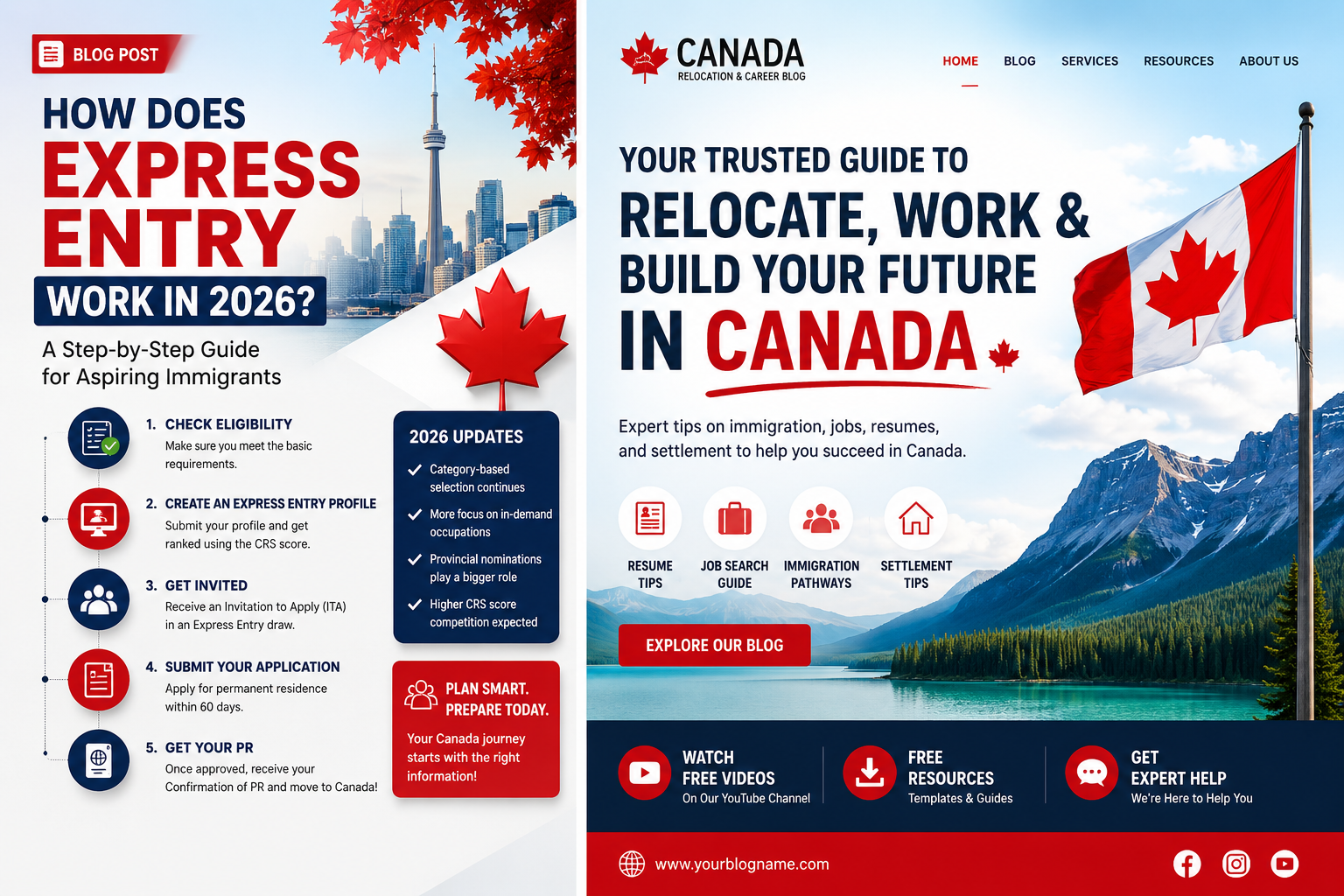
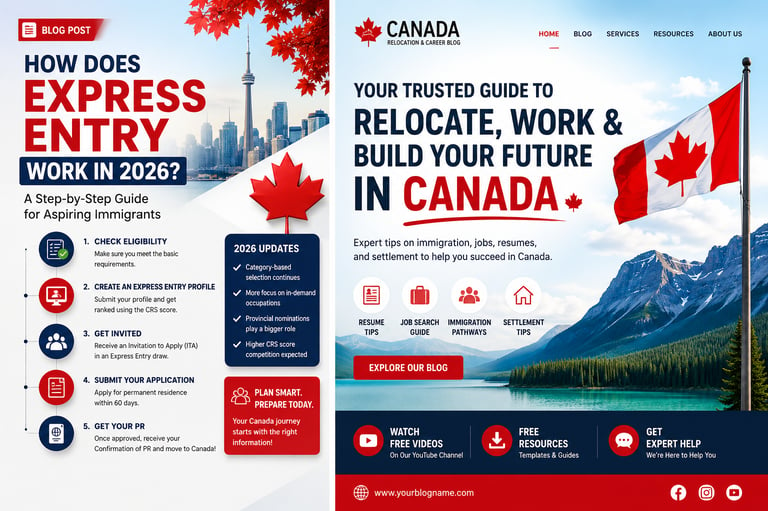
How Does Express Entry Work in 2026? (Plain English Guide)
This article is a complete beginner-friendly guide to understanding Canada’s most popular immigration system which is the Express Entry System
Introduction
You’ve most likely heard that Express Entry is the fastest way to get permanent residence in Canada. You’ve researched about it online, watched YouTube videos and it feels like the more articles or videos you watched the more confused you become. Different websites with new headlines about the express entry system, some emphasizes the CRS scores while others give updates about the different draws held, another person on YouTube says you need over 500 points, and some other persons claiming they got invited with lesser CRS score. I am very sure you’re overwhelmed right now and you need more clarity about how Canada Express Entry actually works in 2026.
So, let’s begin with what is actually true about the Express Entry System?
Express Entry is Canada’s online immigration system for selecting skilled workers who want to relocate to Canada to work and reside their permanently. It used to be a general pool for all skilled workers from different sectors which made it highly competitive but the Good News is that, in 2026, it has become more accessible because it has been categorized to target specific occupations that are still in high demand in Canada. So now, Canada conducts category-based draws targeting specific occupations and French speakers.
In this guide, I’ll explain exactly how Express Entry works in plain English, no complicated immigration jargon, and no confusing government language.
By the end of this article, you’ll understand:
What Express Entry actually is?
How the CRS score works?
How Canada selects candidates?
What steps you need to take?
How to improve your chances of getting Canadian Permanent Residency?
So, if your goal is to really understand how to get Canada PR through Express Entry, this is the guide you’ve been looking for.
What Is Express Entry?
One of the biggest mistake people make is to think that Express Entry is a form of Visa Lottery.
It’s not.
Express Entry is an online system that Canada uses to manage applications for permanent residence from skilled workers. It is like a giant ranking pool where people from all over the world create profiles and once your profile is successfully created it automatically means, you have entered the pool, the system automatically computes your Comprehensive Ranking System (CRS) score using different criteria like your age, work experience, education, language proficiency and so on.
Canada then ranks everyone in the pool based on their CRS scores and regularly invites the top candidates to apply for permanent residence.
Which is why you always hear people talk about CRS scores and Express Entry draws.
There are Three (3) Immigration Programs Managed by Express Entry
1. Federal Skilled Worker Program (FSWP)
This is the most common pathway for people applying from outside Canada. It is specifically for skilled professionals with work experience, education, and language ability.
2. Federal Skilled Trades Program (FSTP)
This pathway is for people in skilled trades like mechanics, electricians, welders, carpenters, and plumbers.
3. Canadian Experience Class (CEC)
This is for people who already have skilled work experience inside Canada, usually international students or temporary foreign workers who are already in Canada.
This is a Simple Analogy
Imagine Canada running a waiting list where everyone gets scored based on their profile.
Every few weeks, Canada checks the list and says:
“Everyone above a particular score range for example between 422-500 gets invited.”
That invitation is called an ITA — Invitation to Apply.
And once you receive it, you can officially apply for Canadian permanent residence WITHOUT JOB OFFER.
That’s how Express Entry Canada work in the simplest possible terms and still works in 2026 with a slight difference.
How the CRS Score Works
Now let’s talk about the most important part of Express Entry:
The CRS Score
CRS stands for Comprehensive Ranking System.
This is the point system Canada uses to rank candidates in the Express Entry pool.
The higher your score, the better your chances of receiving an invitation to apply (ITA) for permanent residency. You do not need to apply to any Job in Canada to get invitations to Apply however, if your CRS score is low and you couldn’t get ITA, getting a Job Offer or Provincial nomination can help boost your score because additional points will be added to your score which could make you surpass the cut-off score and automatically qualify you for an ITA in the next draw.
Your CRS score is based on several factors, but four major things matter the most:
Your age
Your education
Your work experience
Your language test score (IELTS or TEF)
CRS Score Explained in Plain English
Canada wants immigrants who are likely to succeed economically, especially the younger candidates. If you are above 40 years, your age does not disqualify you directly, but you might not be able to meet the cut-off score because the system deducts your score due to your age. Meaning, the older you get, the more your score will be deducted, but you can get an extra point through a job offer or provincial nominations.
The system actually rewards people who are:
Younger
Well educated
Fluent in English or French
Experienced in skilled jobs
Here’s a simplified breakdown of the major scoring areas:
Factor
Approximate Maximum Points
Age - 110
Education - 150
Language Ability - 160
Work Experience - 80
Additional factors include:
Provincial nomination
French language skills
Canadian education (international students)
Valid job offers
Important Truth: You Do NOT Need a Perfect Score
A lot of people panic when they hear someone has 520 CRS points.
But here’s what matters:
You only need a score above the latest draw cutoff.
In 2025 and 2026, category-based draws are changing everything because some selected occupations are now getting invitations even with lower scores.
Healthcare workers, tradespeople, transport workers, agriculture workers, and French speakers now have much better opportunities than before.
That’s why understanding the latest Express Entry draw 2026 trends matter more than obsessing over impossible scores.
Now, let me clarify so as not to get you confused. Even in 2026, the general draw still happens whereby you get selected if you meet the cut-off regardless of your occupation. However, because Canada needs experienced people in some occupations such as healthcare among other occupations currently in high demand, Canada therefore designed separate pool to attract skilled workers from these sectors still under the Express Entry System which means if you occupation falls under any of these in-demand occupations you are not competing in the general pool. It then implies that, if the highest scoring candidate in the category based draws scores 450 then CRS 450 and below would be invited to apply under the category draw while 520 could be the cut-off for the general draw. So, if your occupation falls under the category based draws you might be issued an ITA with a lower CRS.
How Express Entry Draws Work
Canada doesn’t invite people individually.
Instead, the Immigration, Refugees and Citizenship Canada (IRCC) conduct regular draws from the Express Entry pool.
These draws happen roughly every two weeks.
During each draw, Canada announces:
The minimum CRS score required
The number of invitations issued
The category being selected
Two Main Types of Draws
1. General Draws
These include candidates from all occupations and programs.
Usually, the CRS cutoff is higher because everyone competes together.
2. Category-Based Draws
This is the major game-changer introduced recently.
So from 2025, Instead of putting everyone in the same pool, Canada now targets specific occupations facing labor shortages.
These include:
Healthcare
STEM occupations
Skilled trades
Agriculture
Transportation
French-speaking candidates
This means someone with a lower CRS score may still receive an invitation if they work in a priority occupation like I cited an example earlier.
For many applicants, category-based draws are now the easiest path to Canada PR.
Step-by-Step: From Express Entry Profile to PR
Now let’s break down the entire process step by step.
This is where most people get overwhelmed, but it’s actually straightforward once you understand how it works.
Step 1: Check Your Eligibility
First, determine whether you qualify under:
FSWP
FSTP
CEC
Most applicants outside Canada apply through the Federal Skilled Worker Program.
You can check eligibility on the official Canadian immigration website.
Step 2: Take Your Language Test
You must prove your English or French language ability.
Accepted tests include:
IELTS General Training
CELPIP
TEF Canada (French)
Your language score is extremely important because it heavily affects your CRS score. If you are writing IELTS, make sure you target at least Band 8 in Listening, 7 in Writing, Speaking and Reading.
Many people improve their CRS simply by retaking IELTS.
Step 3: Get Your Education Assessed (ECA)
If you studied outside Canada, you’ll need an Educational Credential Assessment (ECA).
This confirms that your foreign degree or diploma is equivalent to Canadian standards.
Popular ECA organizations include:
WES
IQAS
ICAS
Without an ECA, your education points will not count.
Step 4: Create Your Express Entry Profile
Once you have:
Language results
ECA report
Work experience details
You can create your Express Entry profile online.
The system automatically calculates your CRS score.
Step 5: Enter the Pool
After submitting your profile, you officially enter the Express Entry pool.
Now you wait for draws.
If your CRS score is high enough for a draw, you’ll receive an Invitation to Apply (ITA) if not you stay in the pool and try to increase you CRS score. Note that your profile expires after 1 year.
Step 6: Receive an Invitation to Apply (ITA)
This is the big moment.
Once invited, you can officially apply for Canadian permanent residence.
You’ll receive instructions from IRCC explaining what documents to submit.
Step 7: Submit Your Full PR Application Within 60 Days
After receiving your ITA, you have 60 days to upload the following:
Police certificates
Medical exams
Employment letters
Passport documents
Proof of funds
Accuracy is critical here, ensure your documents are accurate.
Mistakes can cause delays or refusals.
Step 8: Wait for Approval
Most Express Entry applications are processed within 6 months.
If approved, you’ll receive:
Confirmation of Permanent Residence (COPR)
Your PR visa (if applicable)
And that’s it — you officially become a Canadian permanent resident.
Now, let’s talk about a very important topic which is;
How to Improve Your CRS Score
If your CRS score feels low, don’t panic.
Many successful applicants improve their score strategically.
Here are three fastest ways among others:
1. Retake IELTS or TEF
Even a small language improvement can significantly boost your score.
Language points are one of the most powerful CRS factors. If you also understand French language, you can also take the French language test alongside the English test and you will be amazed how it can significantly boost your CRS. I heard someone enrolled to learn French language just to boost her CRS and she was able to increase her score and eventually got an ITA because of that. So, it’s doable.
2. Get a Provincial Nomination
A provincial nomination adds 600 extra CRS points.
This practically guarantees an invitation, you can be rest assured that once you get nomination from any Canadian province, you will definitely surpass the next express entry draw cut-off which makes you automatically qualifies you for an ITA.
3. Secure a Valid Job Offer
A genuine Canadian job offer can also drastically increase your points and strengthen your profile.
Some category-based draws also prioritize applicants with relevant work experience.
Can we now talk about;
Common Mistakes Express Entry Applicants Make
Do you know that many applicants delay or ruin their chances of getting selected because of avoidable mistakes.
Here are some common ones:
Waiting Too Long to Start
Some people spend years “researching” without taking action.
Start with your IELTS and ECA early.
Using Wrong NOC Codes
Your occupation code matters. (You can Check your NOC codes Here)
Using the wrong NOC can lead to rejection.
Ignoring Category-Based Draws
Some applicants think they need 500+ CRS points when their occupation may already qualify under targeted draws.
Submitting Incomplete Documents
IRCC is strict.
Missing documents can lead to refusal or delays.
Believing Immigration Myths Online
Not every YouTube video or Facebook group gives accurate information.
Always verify details using official IRCC sources.
Is Express Entry Still Worth It in 2026?
Absolutely.
Despite increased competition, Express Entry remains one of the fastest and most reliable pathways to Canadian permanent residence.
And the system is becoming more occupation-focused than ever before.
That means:
Skilled workers
Healthcare professionals
Tradespeople
French speakers
now have better opportunities even without extremely high CRS scores.
If your occupation matches Canada’s labor shortages, your chances may be stronger than you think.
Final Thoughts
Let’s simplify everything and run through all we’ve discussed again.
Express Entry is:
A ranking pool
Your CRS score is your rank
Canada regularly conducts draws
The highest-ranked candidates receive invitations for PR
That’s the entire system.
And thanks to category-based draws, many applicants with lower CRS scores now have realistic pathways to Canadian permanent residence.
If your dream is to move to Canada, the best thing you can do is start preparing now:
Take IELTS
Get your ECA
Understand your CRS score
Build your strategy early
The sooner you start, the stronger your chances become.
Download Our Free Express Entry Checklist
Want a simple printable guide covering every step from profile creation to PR approval?
Our free checklist includes:
✅ Eligibility checklist (FSWP / FSTP / CEC)
✅ Required documents before applying
✅ Step-by-step Express Entry process
✅ Important IRCC links
✅ PR application timeline
👉 Download the Express Entry Checklist PDF and stay organized throughout your Canada PR journey.
For personalized guidance, visit our Relocate Pathways Guides Page.
Want step-by-step guidance?
Our YouTube channel shares practical videos that simplify the Canada relocation process and help you avoid costly mistakes.


RelocatePathways
Discover the Best Pathways to Permanent Residency in Canada
Contact
Newsletter
canadaimmigrationinfo24@gmail.com
© 2026. All rights reserved.